
Why Is Cold Outreach Shifting from Volume to Timing in 2026?
Cold outreach is becoming less effective, not because of effort, but because of misalignment with buyer behavior. For years, outbound success was driven by volume. More emails, more LinkedIn messages, more calls. But today, inboxes are saturated, attention is fragmented, and engagement-based filters are stricter than ever. Sending more messages no longer increases results; it often reduces them. The real shift isn’t from outbound to inbound. It’s from volume to timing.
Buyers are no longer passive recipients of outreach. They actively signal intent; asking for recommendations, sharing frustrations, and evaluating tools in public. These moments create short windows where engagement is not just accepted, but expected. The teams that win today aren’t the ones reaching the most people. They’re the ones showing up at the exact moment a prospect is ready to engage.
What Is the “Spam Wall” and Why Is Cold Outreach Failing in 2026?
Cold outreach is colliding with what can be described as the Spam Wall: a combination of algorithmic filtering and human fatigue.
Email providers and platforms now prioritize engagement signals over sender intent. If your emails aren’t opened, replied to, or interacted with, future messages are deprioritized or filtered out entirely. At the same time, prospects are overwhelmed with templated outreach, making it harder for any single message to stand out.
The result is a compounding effect: more volume leads to lower engagement, and lower engagement leads to reduced visibility.
Table 1: Cold Outreach — Then vs Now
| Factor | Pre-2023 | 2026 Reality |
|---|---|---|
| Deliverability | Stable | Algorithm-dependent |
| Volume Strategy | Effective | Penalized |
| Personalization | Optional | Mandatory |
| Response Rates | Moderate | Declining |
Cold outreach hasn’t disappeared, but the conditions that made it effective have changed.
How Has Social Selling Evolved into Timing-Based Prospecting?
We’ve already explored the foundations of social selling, where the focus was on building presence, engaging consistently, and staying visible in your market.
But visibility alone is no longer enough. In 2026, the difference between average and high-performing teams is not how often they engage; it’s when they engage.
Consider two scenarios:
A founder posts on LinkedIn:
“We’re struggling to scale outbound, thinking of switching tools.”
-
Team A sees this post three days later and sends a generic pitch
-
Team B responds within hours with a relevant insight or suggestion
Both teams saw the same opportunity. Only one acted within the moment that mattered.
This is where social listening evolves from a passive activity into a timing engine.
It’s not about tracking mentions for awareness. It’s about identifying decision-stage moments, when a prospect is actively evaluating options, and inserting yourself into that conversation before competitors even notice it exists.
That shift from presence to precision is what defines modern B2B growth.
What Is the Difference Between Volume-Based Outreach and Timing-Based Prospecting?
The difference between cold outreach and timing-based prospecting is not just tactical, it’s structural.
Cold outreach assumes demand and tries to create it. Timing-based prospecting identifies demand that already exists and responds to it.
Table 2: Cold Outreach vs Timing-Based Prospecting
| Factor | Cold Outreach (Volume-Based) | Timing-Based Prospecting (Signal-Driven) |
|---|---|---|
| Timing | Fixed schedules | Real-time, trigger-based |
| Targeting | Assumed fit | Verified intent signals |
| Context | Generic messaging | Contextual, situation-aware |
| Engagement | Low response rates | Higher response likelihood |
| Competition | High | Lower (few act in time) |
| Efficiency | High effort, low yield | Focused effort, higher ROI |
In practice, this means:
A cold email sent to 1,000 prospects might generate a handful of replies.
A single well-timed response to a high-intent conversation can generate a qualified lead instantly. The advantage is not scale, it’s relevance at the right moment.
What Is the Golden Window and Why Does Timing Matter in B2B Sales?
Every buying decision has a moment where attention is highest and openness to new solutions is at its peak. This is the Golden Window.
It begins the moment a prospect expresses intent, asking for recommendations, sharing a frustration, or evaluating alternatives, and lasts only until that need starts getting resolved. What makes this window powerful is not just that it exists, but that it is short, competitive, and often invisible to teams relying on traditional outreach.
Most B2B teams miss this entirely. They operate on schedules: weekly campaigns, monthly sequences, and pre-built lists. By the time they reach out, the prospect has already gathered opinions, shortlisted options, or moved forward with someone who responded earlier.
Infographic 1: Introducing Golden Window
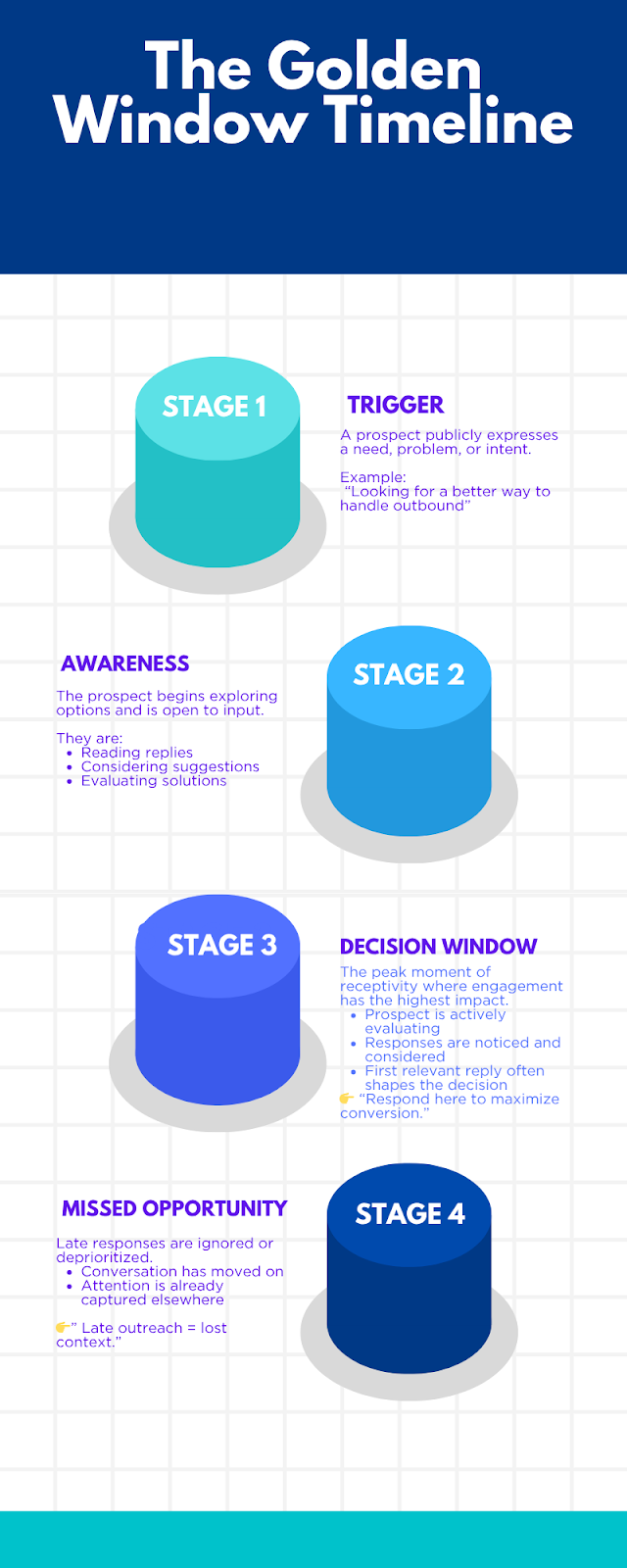
In contrast, timing-based engagement works because it aligns with how decisions actually happen.
When someone posts:
“Looking for a better way to handle outbound.”
or
“Anyone recommend alternatives to [X]?”
They are not browsing casually. They are actively forming a decision. At that moment, responses are not interruptions; they are inputs.
The first few relevant responses often shape the direction of that decision. They introduce options, frame expectations, and establish early trust. Later responses, even if better, are often ignored because the conversation has already moved forward.
This is why timing is not just an advantage; it is leverage.
Infographic 2: Response Timing and Speed

The Golden Window is where outbound stops feeling like outreach and starts feeling like relevance. And in a market where attention is limited and competition is high, that distinction is what determines whether you are considered or overlooked.
How Can You Turn Timing into a Repeatable Prospecting System?
Understanding timing is one thing. Executing it consistently is where most teams fail. To operationalize timing, you need a system, not just awareness.
Step 1: Listen - Identify Live Intent Signals
Start by defining what matters:
-
Problems your product solves
-
Competitors in your space
-
Keywords prospects naturally use
Instead of building static lead lists, you are now building a live feed of opportunities.
Step 2: Verify - Separate Noise from Real Intent
Not every mention is actionable.
A useful filter:
-
Is the problem clearly stated?
-
Is the user asking for input or advice?
-
Is there urgency or frustration?
For example:
-
“Anyone tried X?” → weak signal
-
“Need an alternative to X ASAP” → strong signal
This step ensures you focus only on high-probability conversations.
Step 3: Act - Engage Within the Golden Window
Speed is critical, but relevance matters more.
A strong response:
-
Addresses the specific problem
-
Adds value (not just a pitch)
-
Positions you as helpful, not transactional
For example, instead of:
“We offer a solution for this.”
You respond with:
“We’ve seen this happen when teams rely on volume-based outreach, one approach that’s working now is…”
This shifts perception from seller → contributor.
Step 4: Learn - Refine What Signals Work
Track:
-
Which signals convert
-
Which platforms perform best
-
What messaging resonates
Over time, this becomes a predictable acquisition channel, not an experiment.
How Does Keyword Scouter Help You Capture High-Intent Leads in Real Time?
Once timing becomes your advantage, the real challenge is consistency. Opportunities don’t appear in one place: they’re scattered across platforms, time zones, and conversations.
This is where KeywordScouter, changes the equation. Instead of searching for leads, Keyword Scouter builds a real-time intelligence layer across Reddit, LinkedIn, and X.
It continuously monitors conversations based on your defined keywords and surfaces only the ones that matter, every 30 minutes.
That means:
-
You don’t miss the Golden Window
-
You don’t waste time on low-intent noise
-
You engage when it actually matters
It doesn’t stop at discovery.
With built-in classification, you can instantly identify whether a post is:
-
A problem
-
A competitor mention
-
A high-priority opportunity
And with AI-generated replies, you remove the biggest bottleneck in execution, response time.
Table 3: Manual Prospecting vs Keyword Scouter
| Task | Manual Approach | Keyword Scouter |
|---|---|---|
| Lead discovery | Manual searching | Automated, keyword-driven |
| Timing | Delayed, inconsistent | Real-time (30-min intervals) |
| Signal filtering | Manual judgment | Smart classification |
| Response speed | Slow | Instant (AI-assisted) |
| Platform coverage | Limited | Reddit, LinkedIn, X |
Real-time, context-based outreach changes how prospects respond, but the impact becomes clearer when you look at how it performs in practice.
Instead of reaching out based on static lists, outreach is anchored to something the prospect has recently shared. This shifts the interaction from interruption to relevance. The difference is subtle in execution, but significant in outcome.
Infographic 3: Keyword Scouter's Unique Selling Point
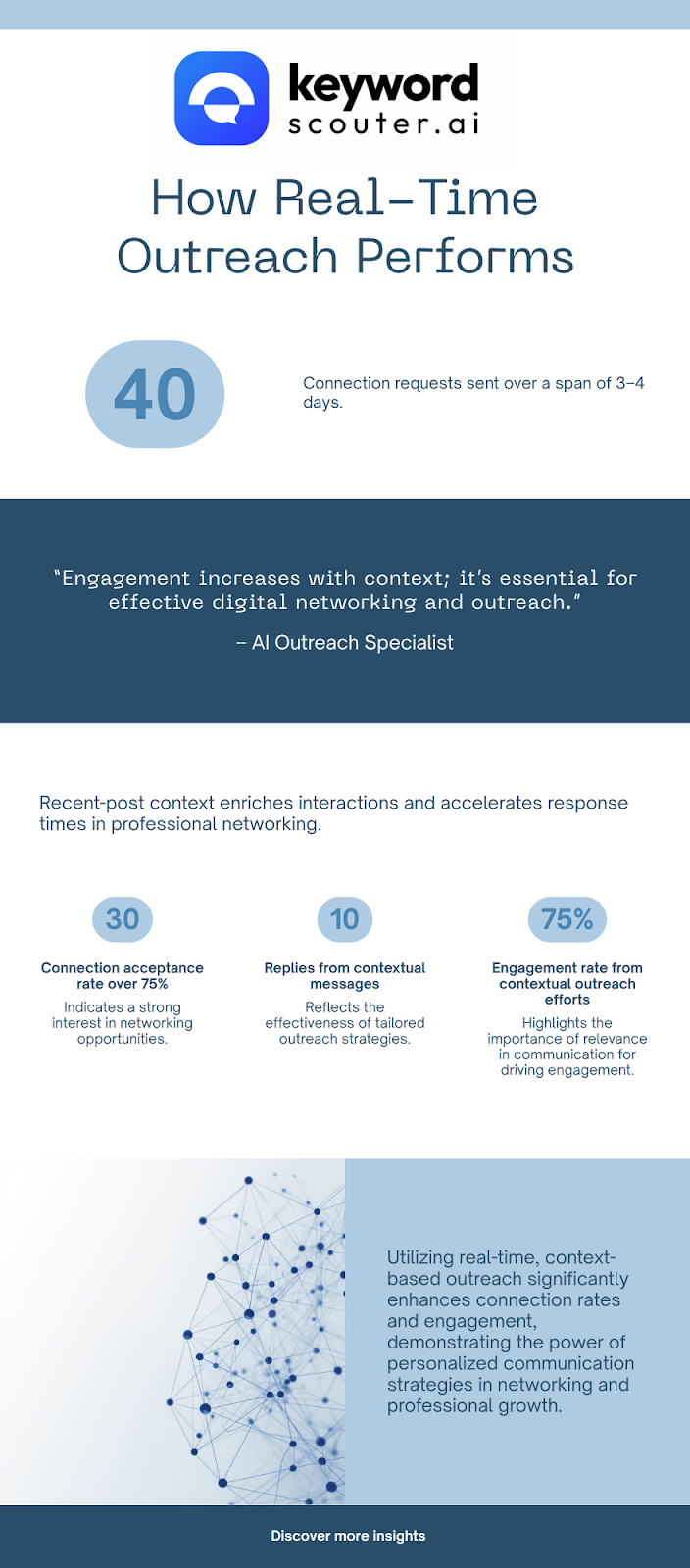
What stands out is not just the acceptance rate, but the quality of engagement that follows. Responses are more conversational, less dismissive, and more likely to turn into meaningful exchanges.
This is because the message arrives within the prospect’s current context. It aligns with what they are already thinking about, rather than introducing something new out of the blue.
Over time, this pattern compounds. Instead of relying on volume to generate a few responses, you rely on timing and context to generate consistent engagement.
How Do You Scale Timing-Based Prospecting Across Multiple Platforms?
Capturing one opportunity is useful. Capturing them consistently is what drives growth.
As explored in The Early Bird Gets The Lead: Why Speedy Social Engagement Wins Business, the first relevant response often shapes the entire conversation.
This creates a compounding advantage:
-
Faster responses → higher engagement
-
Higher engagement → better visibility
-
Better visibility → more inbound opportunities
Over time, this shifts your pipeline from:
-
Outbound-driven → signal-driven
-
Effort-heavy → insight-driven
Timing stops being a tactic and becomes a repeatable growth engine.
Frequently Asked Questions
-
Is cold outreach still effective in 2026?
Yes, but only when combined with timing signals. Generic, high-volume outreach is declining in effectiveness, while targeted outreach based on real-time intent continues to perform. -
What is intent-based prospecting?
Intent-based prospecting focuses on engaging prospects who are actively signaling a need, rather than reaching out to broad, unqualified lists. -
How do you identify high-intent leads?
By monitoring public conversations for signals such as problem mentions, competitor discussions, hiring activity, and strategic changes. -
When is the best time to reach out to prospects?
Immediately after an intent signal is observed, within the “Golden Window” when the prospect is most receptive. -
What are alternatives to cold outreach?
Alternatives include social listening, inbound marketing, and community engagement, all of which rely on engaging prospects based on intent rather than interruption.
Conclusion
Cold outreach isn’t disappearing, but it’s no longer enough on its own.
The landscape has shifted from reaching more people to reaching the right people at the right moment. And that shift changes everything.
The teams that continue to rely on volume will find diminishing returns. The teams that learn to recognize and act on intent signals will operate with a completely different level of precision.
Timing is no longer a small advantage; it is the deciding factor.
If you understand when a prospect is ready, you don’t need to convince them to listen. You simply need to show up.
And in a market where attention is scarce and competition is constant, that difference is what turns conversations into customers.